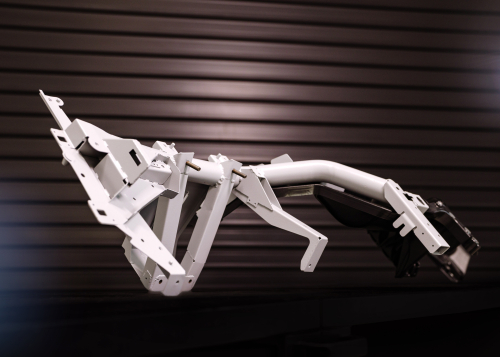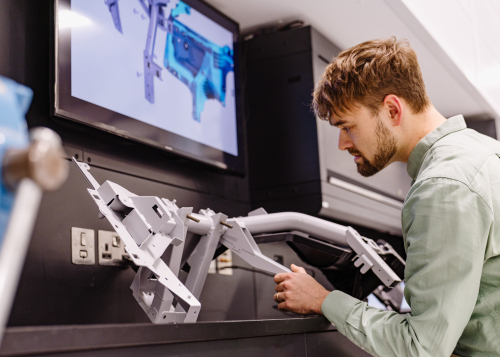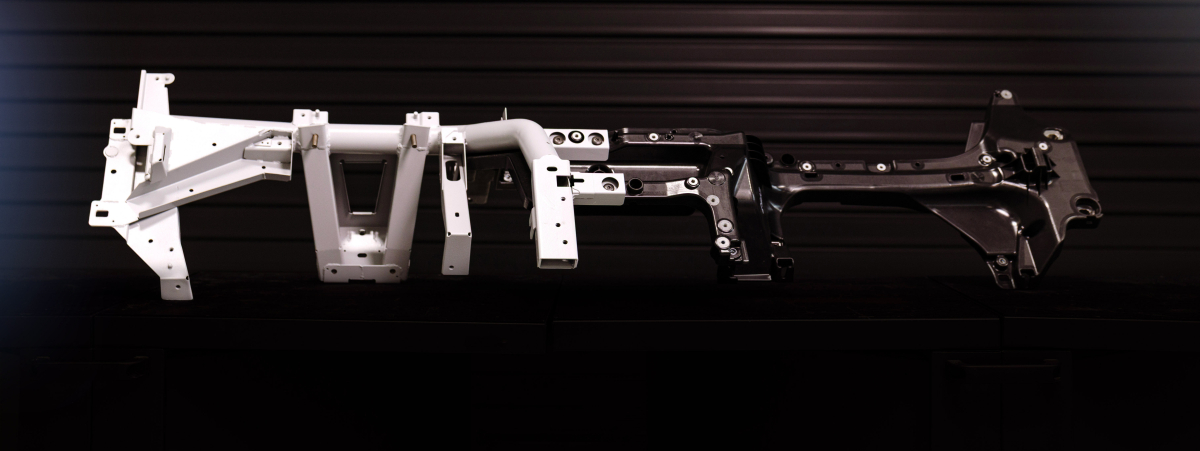
- JLR has successfully reengineered the crosscar beam, a crucial part of a vehicle’s safety system, for its future vehicles using a hybrid solution of fibre‑reinforced plastic and steel.
- By removing carbon‑intensive magnesium from the crosscar beam, this innovation is projected to cut over 50,000 tonnes of CO₂ annually* – equivalent to the average yearly energy use of approximately 17,000 UK homes**
- Engineering breakthrough maintains safety and structural integrity of the company’s luxury vehicles while delivering refined driving experiences for its clients.
Gaydon, UK, Thursday 11th December 2025: Luxury automotive manufacturer JLR has reengineered one of the most structurally important but carbon intensive components within its future vehicles ‑ the instrument panel crosscar beam.
The crosscar beam, which spans the width of the vehicle behind the dashboard, is a critical structural backbone in a vehicle’s cockpit, playing a key role in passenger safety, protecting occupants and mounting airbags, while reducing noise and vibration to keep the cabin calm and refined. Traditionally made from magnesium or steel, the new crossbeam structure is a composite material comprising fibre‑reinforced plastic and steel.
This engineering breakthrough is expected to cut over 50,000 tonnes of CO₂ annually* ‑ equivalent to the average yearly energy use of around 17,000 UK homes** ‑ all without compromising the luxury and refinement for JLR’s clients. This reduction comes from eliminating magnesium from the crosscar beam, which is highly carbon intensive to produce, in favour of a much lower carbon solution.
This innovation is a testament to the ingenuity of our engineering, sustainability and supplier teams. By reimagining a component that’s hidden from view, we are able to reduce carbon emission from future vehicles, setting a new benchmark for sustainable architectures for our next generation of luxury cars ‑ without compromising on safety or quality.
Thomas Mueller, Executive Director of Product Engineering at JLR
Redesigning a structural component like this isn’t just a straight materials swap ‑ it’s a complex engineering challenge. Working collaboratively with our suppliers, we had to ensure the new hybrid material met exacting standards for safety, refinement and durability, while delivering a significant CO₂ reduction. It’s a clear demonstration of how research and collaboration can drive meaningful sustainability improvements without compromise.
Matthew Atkinson, Lead Research Engineer at JLR
Initially a research project with suppliers Celanese, CCP Gransden and Petford Group, the material underwent rigorous testing, proving that the hybrid structure combines the lightweight properties of fibre‑reinforced plastic with the stiffness and strength of steel. Fibre‑reinforced plastic can also be engineered to absorb energy effectively during impact, and when paired with steel, helps maintain the instrument panel’s structural integrity.
JLR’s cross‑car beam innovation illustrates the luxury automotive’s Reimagine strategy in action, aiming to deliver a sustainability‑rich vision of modern luxury by design.